design <- getDesignGroupSequential(
    sided = 2,
    alpha = 0.05,
    beta = 0.2,
    informationRates = c(0.3, 0.6, 1),
typeOfDesign = "asOF")Design Specification in rpact
Gernot Wassmer
January 14, 2026
Work-flow for sample size calculations in rpact
- Define abstract group-sequential boundaries which are applicable to any type of endpoint (
getDesignGroupSequential()). - Feed these boundaries into endpoint-specific sample size formulas (e.g.,
getSampleSizeMeans(),getSampleSizeRates(),getSampleSizeSurvival(),getSampleSizeCounts(),getSimulation...(),getPower...()).
For trials without interim analyses, Step 1. can be omitted. getDesignInverseNormal()yields the same results asgetDesignGroupSequential(), it has an effect only for simulation and analysis.getDesignFisher()provides no planning calculation, use the simulation tools instead.
Abstract group-sequential boundaries
Function getDesignGroupSequential() derives group-sequential boundaries in the mathematically simplest case:
- Single arm trial with independent \(X_i \sim N(\mu,1)\)
- Test \(H_0: \mu = 0\) against \(H_1: \mu = 1\)
- Correlation structure between \(Z\)-statistics at interim and final analyses is identical for more complex situations (e.g., binary, continuous and survival endpoints).
Group-sequential boundaries and properties of the design apply to all endpoints!
Example: O’Brien-Fleming type \(\alpha\)-spending
informationRates: information fractions at which interim and final analysis are conducted.- Information fraction \(t_k\) at analysis \(k\):
- Binary and normal outcomes: \(t_k = n_k/N_{max}\)
- Survival outcomes: \(t_k = d_k/d_{max}\) where d is # events.
typeOfDesign = "asOF": O’Brien and Fleming type \(\alpha\)-spending.
Supported efficacy boundaries
Argument typeOfDesign:
- Exact O’Brien & Fleming (“OF”), Pocock (“P”), Wang and Tsiatis (“WT”), Haybittle and Peto (“HP”)
- Pampallona and Tsiatis (“PT”) one-sided and two-sided designs
- O’Brien & Fleming and Pocock type \(\alpha\)-spending (“asOF” and “asP”)
- Kim & DeMets (“asKD”) and Hwang, Shi and DeCani \(\alpha\)-spending (“asHSD”) and \(\beta\)-spending (“bsKD” and (“bsHSD”))
- User-defined \(\alpha\)-spending (“asUser”) and \(\beta\)-spending (“bsUser”)
- No early efficacy stops (“noEarlyEfficacy”)
Example: Futility boundaries
# Example: non-binding futility boundary at first interim in
# case estimated treatment effect is null or in "the wrong
# direction", no futility at second interim
design <- getDesignGroupSequential(
    sided = 1,
    alpha = 0.025,
    beta = 0.2,
    informationRates = c(0.3, 0.6, 1),
    typeOfDesign = "asOF",
    futilityBounds = c(0, -Inf),
    bindingFutility = FALSE)
summary(design)futilityBounds: Vector on \(z\)-value scale for interim analyses (excluding final analysis).z = 0: Futility if “null effect or effect in wrong direction”z = -Inf: No futility at this interim analysisbindingFutility = FALSE(default): no effect on efficacy boundaries.futilityBoundsonly supported for one-sided testing.
Example: Futility boundaries
Sequential analysis with a maximum of 3 looks (group sequential design)
O’Brien & Fleming type alpha spending design, non-binding futility, one-sided overall significance level 2.5%, power 80%, undefined endpoint, inflation factor 1.0718, ASN H1 0.8826, ASN H01 0.8852, ASN H0 0.695.
| Stage | 1 | 2 | 3 |
|---|---|---|---|
| Planned information rate | 30% | 60% | 100% |
| Cumulative alpha spent | <0.0001 | 0.0038 | 0.0250 |
| Stage levels (one-sided) | <0.0001 | 0.0038 | 0.0238 |
| Efficacy boundary (z-value scale) | 3.929 | 2.670 | 1.981 |
| Futility boundary (z-value scale) | 0 | -Inf | |
| Cumulative power | 0.0096 | 0.3359 | 0.8000 |
| Futility probabilities under H1 | 0.056 | 0 |
Additional characteristics of the design
Group sequential design characteristics
- Number of subjects fixed: 7.8489
- Shift: 8.4123
- Inflation factor: 1.0718
- Informations: 2.524, 5.047, 8.412
- Power: 0.009643, 0.335884, 0.800000
- Rejection probabilities under H1: 0.009643, 0.326241, 0.464116
- Futility probabilities under H1: 0.05607, 0
- Ratio expected vs fixed sample size under H1: 0.8826
- Ratio expected vs fixed sample size under a value between H0 and H1: 0.8852
- Ratio expected vs fixed sample size under H0: 0.6950
Number of subjects fixed: for abstract design without interim analyses.Shift: Maximal sample size for abstract design with interim analyses.Inflaction factor: Maximum sample size increase of sequential design relative to design without interim analyses.Ratio expected vs fixed sample size: Reduction in expected sample size of sequential relative to fixed design.
Stopping probabilities under \(H_0\) and \(H_1\)
Power and average sample size (ASN)
User defined parameters
- N_max: 8.4123
- Effect: 0
Output
- Average sample sizes (ASN): 5.455
- Power: 0.02344
- Early stop: 0.5038
- Early stop [1]: 0.500043
- Early stop [2]: 0.003758
- Early stop [3]: NA
- Overall reject: 0.02344
- Reject per stage [1]: 4.273e-05
- Reject per stage [2]: 0.003758
- Reject per stage [3]: 0.01964
- Overall futility: 0.5000
- Futility stop per stage [1]: 0.5000
- Futility stop per stage [2]: 0.0000
Legend
- [k]: values at stage k
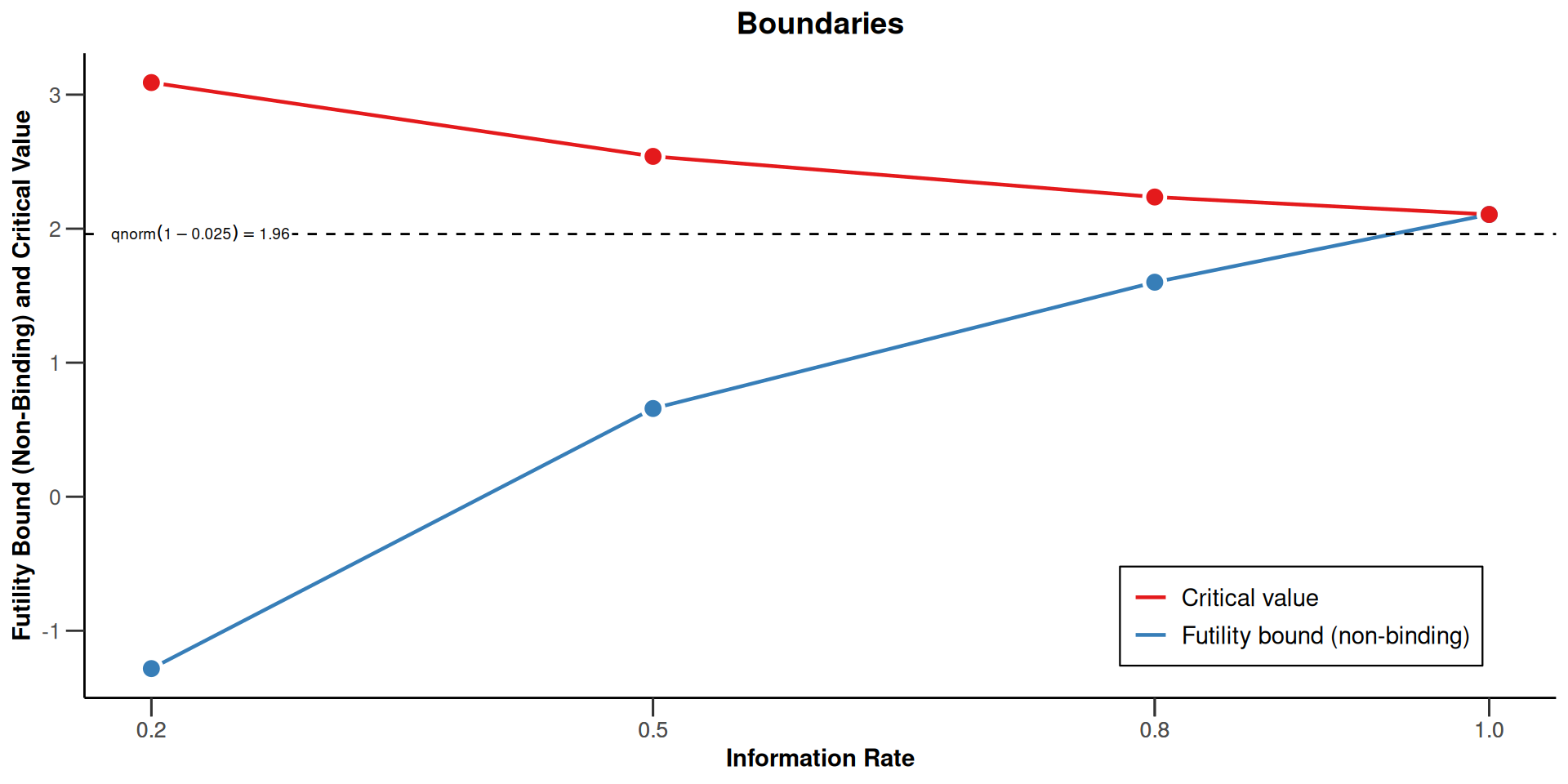
Example: Derivation of futility bounds
More on group-sequential boundaries
E.g., vignette Defining group-sequential boundaries with rpact, written with Marcel Wolbers.
Also contains information on:
- Extracting information from
rpactobjects - \(\beta\)-spending functions for futility
- Plotting
rpactobjects